Pakistani mango varieties: names, seasons and a guide to the different types
Pakistani mango varieties at a glance
Pakistan’s best-known mango varieties include Sindhri, Anwar Ratol, Sammar Bahisht Chaunsa, White Chaunsa, Black Chaunsa, Dusehri, Langra and Fajri. The wider picture includes local orchard selections and introduced mangoes held in research collections.[1, 2]
Use this guide to compare the main types, find their published harvest windows and look up less familiar names, including Abdali, the mango of our partner grove in Multan.
This is a broad, source-led guide to documented names, not a claim to have identified every mango tree or genetically distinct cultivar in Pakistan. Research accessions, regional names and growers’ selections are identified separately. How we researched it: every claim is tied to a numbered source at the foot of the page, and names follow the spelling of the record they come from.
A summer told in mangoes
Ask someone in Pakistan which mango is best and you are likely to hear a name, a place and a memory. A crate arriving from Multan. The first Sindhri of the summer. A particular tree in a family orchard.
The familiar names are only the beginning. Behind them are regional selections, experimental crosses, imported cultivars and mangoes known chiefly to the people who grow them.
This guide starts with the varieties you are most likely to meet, then opens out into that wider collection. It explains when mangoes are harvested, why names overlap and what the evidence actually tells us about the less familiar fruit.
The short answer
Sindhri, Anwar Ratol and the Chaunsa selections are among Pakistan’s best-known mangoes. Dusehri, Langra and Fajri are important names too. Sindh and Punjab form the heart of the industry, with production also recorded in other regions. The main season begins in May and continues through summer; late selections extend the calendar beyond August.[1, 2]
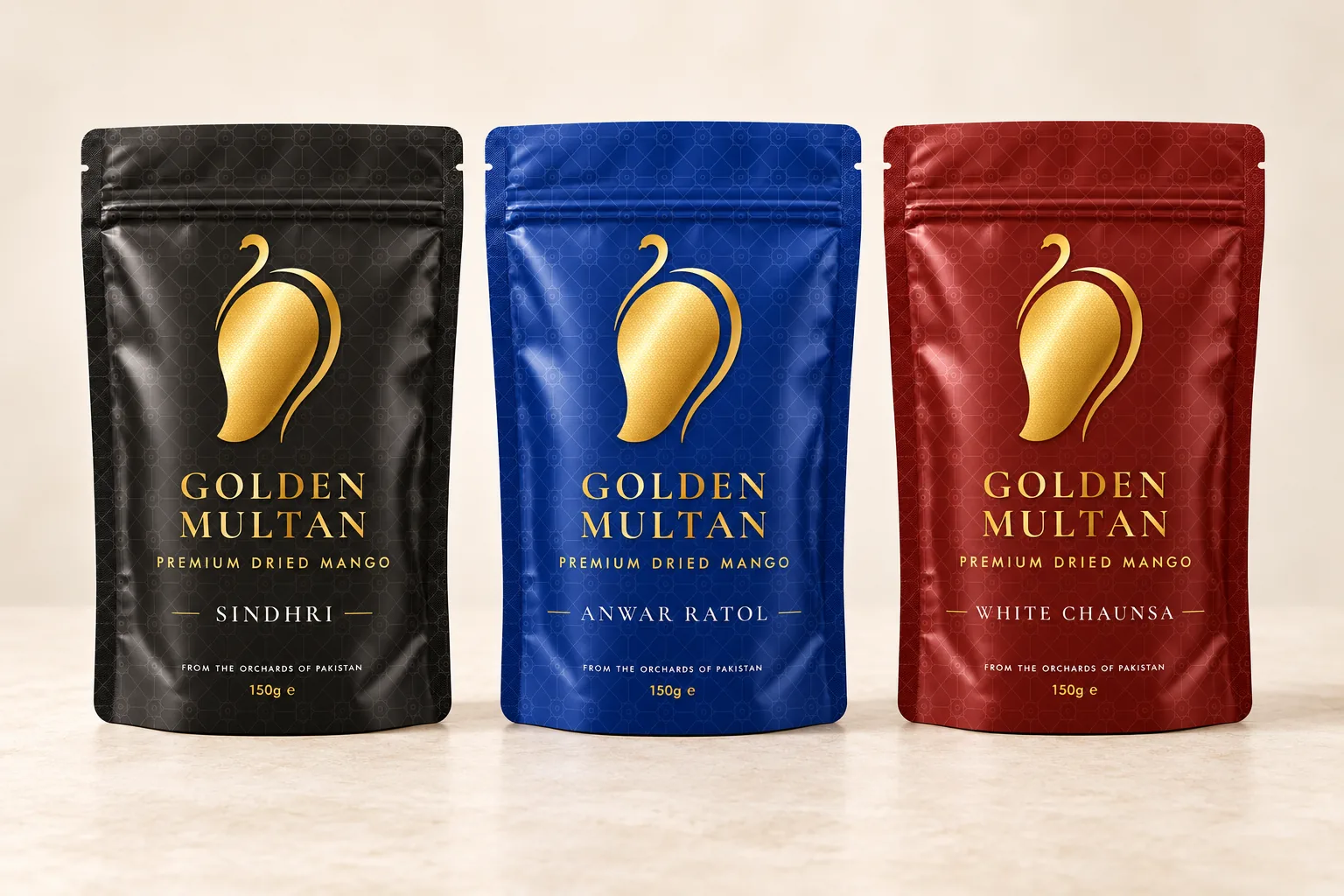
At Golden Multan, our main dried mango range focuses on Sindhri, Anwar Ratol and White Chaunsa. This guide also covers mangoes we do not sell: understanding the wider fruit is part of understanding those three.
When are mangoes picked in Pakistan?
There is no single picking date for “Pakistani mango”. Variety, location and the year’s growing conditions all matter. Nor is a harvest date necessarily the date a mango is ready to eat: maturity at picking and ripeness at the table are different things.
Sindh generally opens the commercial season, followed by Punjab. A national planning report describes a broad season from mid-May to late September. Some Punjab cultivar references give availability extending into October. These describe different scales of observation, rather than a promise that every variety is available for months.[1, 2]
A practical harvest calendar
The following windows come from Punjab’s Mango Research Institute listing. They are reference ranges, not nationwide dispatch dates.[2]
| Variety | Published reference window |
|---|---|
| Sindhri | Early June–early July |
| Anwar Ratol | Early June–early July |
| Dusehri | Early June–early July |
| Langra | Early June–early July |
| Yakta | End of June |
| Sammar Bahisht Chaunsa | Mid-July–early August |
| Chenab Gold | Mid-July–mid-August |
| Fajri | Mid-August–mid-October |
| Late Retaul / Retaul No. 12 in this listing | Mid-August–mid-October |
| Kala Chaunsa | Mid-August–mid-October |
| Sufaid / White Chaunsa | Mid-August–mid-October |
| Azeem Chaunsa | Mid-September–mid-October |
Use the calendar to understand the succession of varieties. Ask the orchard about the actual season when buying fresh fruit.
The three mangoes at the heart of Golden Multan
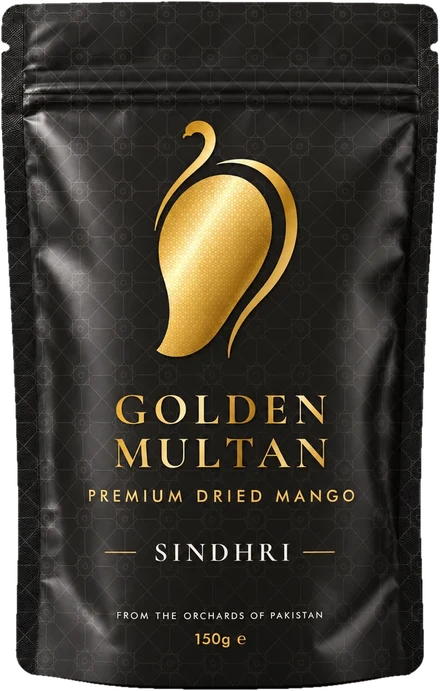
Sindhri سندھڑی
The early-season starting point.
Sindhri is closely associated with Sindh. Research on fruit collected in Mirpurkhas describes a substantially larger mango than Langra, with a pleasant aromatic flavour. Its generous proportions make it an easy variety to recognise beside the smaller mangoes in a mixed box.[3]
For someone beginning to explore Pakistani mangoes, it is a useful first reference: learn its shape and aroma, then compare another cultivar alongside it.
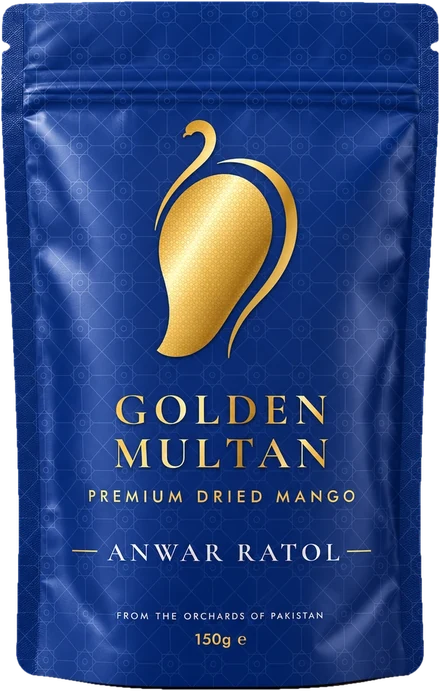
Anwar Ratol انور رٹول
Small fruit, a celebrated flavour.
Also written Anwar Rataul, Anwar Retaul and Anwar Ratole, this is a much smaller mango than the large Sindhri examples in official trade material. That material highlights its flavour and records very little fibre beneath the skin.[4]
Its size is part of its identity, rather than a measure of its quality. Compare it with Sindhri for the difference between two named varieties, rather than assuming that all Pakistani mangoes are the same fruit in different sizes.
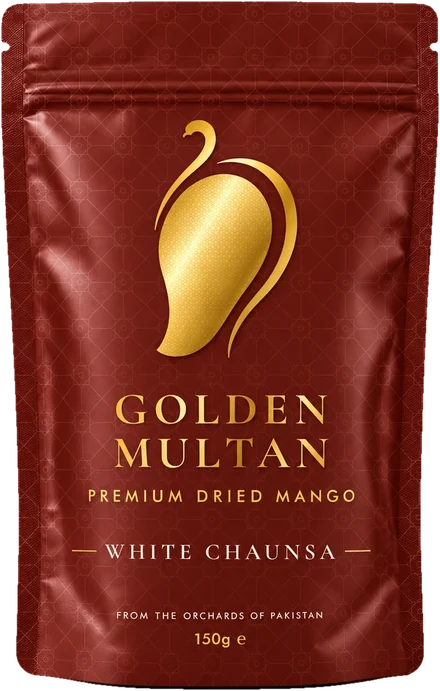
White Chaunsa سفید چونسہ
A late-season Chaunsa selection.
White Chaunsa appears in agricultural sources as Sufaid, Safaid or Safeed Chaunsa. Official trade material describes whitish-yellow flesh and late availability. It is a specific selection, and should not be treated as interchangeable with every mango sold simply as Chaunsa.[4]
Its late position is worth understanding: the Pakistani mango season does not finish when the first major summer varieties disappear.
What changes when mango is dried?
For a useful tasting comparison, try the three varieties together. Notice aroma, acidity, sweetness, chew and the length of the finish.
Fresh-fruit research cannot establish the exact flavour of a finished pouch. Slice thickness, fruit maturity and drying conditions need to be considered alongside variety. That is why our own tasting notes will describe the batches we actually produce at our site in Dharabi, Chakwal.
Understanding Chaunsa
“Chaunsa” is often used as if it meant one identical mango. Agricultural references distinguish several named selections.[2, 5]
| Name | How to read it |
|---|---|
| Sammar Bahisht Chaunsa / SB Chaunsa | A separately named cultivar; spellings include Samar Bahisht |
| Sufaid Chaunsa / White Chaunsa | A separately named late selection |
| Kala Chaunsa / Black Chaunsa | A separately named selection |
| Azeem Chaunsa | A named cultivar listed by the Mango Research Institute |
| Rampuri Chaunsa | A name recorded in germplasm research |
If a seller offers “Chaunsa”, asking which selection is a reasonable question. A cultivar name gives a more useful starting point for comparison than a broad market label.
A popular naming tradition connects Chaunsa with Sher Shah Suri and the Battle of Chausa in 1539. It is part of how the mango is talked about, but it does not establish the pedigree of modern White Chaunsa, and this guide does not use it as a documented origin account.
Other established and lesser-known mangoes
The Shujabad germplasm catalogue is valuable because it gives space to cultivars beyond the best-known commercial names. Its seasonal groupings include the following. These are catalogue classifications, not a universal harvest timetable.[5]
| Catalogue grouping | Named entries |
|---|---|
| Early | Aalishan, Yakta, Dusehri, Langra, Early Gold |
| Mid-season | Rohaan, Ghulab-e-Khas, Badia Muna Syed, Kensington Pride, Spring Fells, Zafran, Bagan Phali, Intikhab, Anmole |
| Late | Golden, Hasaan, Fajri, Aaminia, Shah Pasand, Zard Aalu, Taimuria, Sobey de Ting, Sensation, Pohilot |
Dusehri and Langra
Both deserve a place alongside the headline names. Dusehri appears under several English spellings, including Dussehri and Dashehari. Langra has been studied in Sindh as well as appearing in Punjab references; the Mirpurkhas comparison describes a distinctive turpentine-like aroma. Here that term is a sensory descriptor used by researchers.[1, 3]
Fajri
Fajri is included in national industry material and in the Shujabad catalogue’s late group. Sources also use expanded labels such as Fajri Kalan. Preserve the full name when identifying a particular orchard’s fruit.[1, 5]
Aalishan and the role of breeding
The catalogue identifies Aalishan as a cross between Anwar Retaul and Sanglakhi. It is a useful reminder that mango diversity includes deliberate breeding as well as selections found in orchards.[5]
Chenab Gold and Azeem Chaunsa
These appear in the Mango Research Institute’s published listing. Their inclusion matters because a guide should leave room for cultivars beyond the familiar retail assortment.[2]
Bangan Pali and Bombay Alphonso
National industry material records Bangan Pali and Bombay Alphonso among Pakistan’s mango names. A variety grown in Pakistan need not have originated within its modern borders.[1]
A wider catalogue of documented mango names
The following index records names from a 2026 study of 89 accessions at Mango Research Station, Shujabad. It includes local material, hybrids and introductions. A research accession is an identified item in a collection; its presence does not demonstrate widespread commercial cultivation.[6]
This index deliberately avoids assigning flavour notes or nationwide seasons where those would go beyond the evidence. Names follow the research record, including unusual spellings. They should not all be interpreted as separate, authenticated commercial varieties available to buy.
89 names
Local and established South Asian material in the study (47)
- Shah Pasand
- Haider Shah Wala
- Survarnareeka
- Saroli
- Yakta
- Chaunsa (Samar Bahisht)
- Sindhri
- Malda Late
- Kala Chaunsa
- Sufaid Chaunsa
- Retaul Late
- Sanglakhi
- Sobe de Ting
- Pohilot
- Taimuria
- Chaunsa (Rampuri)
- Saleh Bhai
- Zafran
- Burma Surkha
- Badia Muna Syed
- Almas
- Intikhab
- Anmole
- Bombay Alphanso
- Ghulab Khas
- Bara Mashi
- Anwar Retaul
- Tota Pari
- Langra Mai Wala
- Pan
- Lab-e-Mashooq
- Lahotia
- Joiya Wala
- Amer Gola
- Kachnali Wala
- Dusehri Late
- Ghulam Muhammad Wala
- Golden
- Aminia
- Chenab Gold
- Azeem Chaunsa
- Zardalu
- Fajri
- Bangan Palli
- Neelum
- Langra
- Dusehri
Hybrids in the study (3)
- Aalishan
- Rohan
- Hasaan
Introduced material in the study (39)
- Early Gold
- Sensation
- Keitt
- Maya
- Tomy Atkin
- Zill
- Momi-K
- Spring Fells
- Pope
- Haden
- Collector
- Maha 165
- Bullocks Heart
- Brown Seedling
- Carabao Lamao
- Carabao Super Manila
- Indochinese Late
- Pirie
- Kuru
- Gratidge
- Carabao Timiteo
- Sapa
- 13_1
- Keo Savoey
- Olour
- Palmer
- Banana Long
- Rockdale Siagon
- Rupee
- Kasturi
- Kensington Pride
- Xoai Boui
- Xoai Cat Hoa Loc
- Australian Common
- Koew
- Rosa
- Crimson Blush
- R2E2
- Kent
Additional names in genetic research
A separate 2026 study of material from Multan’s research collection includes Falan, Mosami Sindhri, Late Sindhri, Carabao Lemon, Jakarta, Tong Dum and Elephant Tusk. It also uses forms such as Keow Savoy, Olur and Maha.[7]
Some may correspond to names or selections elsewhere in the literature. They are retained here as source labels, without assuming that a spelling resemblance proves identity. Conversely, a different spelling is not enough evidence to declare a new variety.
This distinction is especially useful for imported mangoes. A collection’s recorded source country may describe where planting material was obtained, rather than where the cultivar first arose. The geographical labels in research tables should not automatically become definitive origin stories.
Local mangoes beyond the main commercial belt
Begum Pasand
Reporting from the 2017 National Mango and Summer Fruits Festival in Mirpurkhas identifies Begum Pasand at Gondal Farms. It is an additional documented name beyond the research index above; that report alone is insufficient for a reliable harvest calendar or detailed cultivar specification.[14]
Bhimber and the mangoes of Azad Jammu and Kashmir
A 2023 field study in the Barnala area of Bhimber examined seven locally named mango types: Langra, Moota, Peela, Kala, Sanduri, Khakharia and Gola. Spellings vary within the paper, including Mota and Goala.[8]
These names deserve to be recorded, but their local context matters. “Kala” in this study should not automatically be equated with Kala Chaunsa, nor should every mango called Gola be assumed to be the same clone.
Panyala Langra
An Agriculture Research Institute, Dera Ismail Khan contribution to the 2022 International Horticulture Conference reports the selection and registration of Panyala Langra. This gives it a stronger documentary basis than an unreferenced market name.[9]
Camal Wala and Faiz Kareem
A 2011 study of indigenous germplasm from Khanewal, Multan and Muzaffargarh identified Camal Wala and Faiz Kareem among selections with distinctive fruit characters and market potential. Their appearance in research is a reason to preserve the names, rather than an assurance of current retail availability.[10]
Sunera, Lal Badhsa and Pallet
An official account of Pakistan’s 2022 mango festival in London lists these names among the fruit exhibited. The report establishes their use at that event; it does not provide enough detail to resolve their identity, parentage or harvest dates.[11]
Abdali: the mango of Masha Allah Bagh, Multan
Abdali belongs in a serious guide because it is a name readers may encounter outside conventional cultivar lists. It is the name under which Masha Allah Bagh, a mango grove in Multan, sells its fruit.
The grove’s own public material promotes Abdali mangoes, including a June 2021 post and June 2025 material. Another post uses the wording “Aman Abdali”. These establish that the names are used by the grower.[12]
The grove’s own film adds its account of itself: mangoes grown since 1898, a founder, Hamid Khan Durrani, who spent decades experimenting with varieties and wrote a book on them, more than 200 varieties collected from around the world, and parent plants that it says have supplied saplings to all of Pakistan’s major mango-growing regions over the last seven decades.[15] These are the grower’s claims, reported as such.
A disclosure: Masha Allah Bagh is Golden Multan’s official partner farm. We say so plainly because this guide is meant to be a neutral reference, and readers deserve to know about the relationship when they read this entry.
The published material does not yet establish a verified pedigree, formal cultivar registration, a measured flavour profile or the exact relationship between Abdali and Aman Abdali. Until it does, this guide records Abdali as a grower-associated name, and leaves those questions open rather than filling them with marketing.
For a mango known primarily through one orchard, the best evidence is an account from the grower identifying the original trees, their propagation history, distinguishing traits and normal picking period. Working with the grove, we intend to document exactly that, with photographs, and to publish it here as a clearly attributed orchard profile. Meanwhile, you can read about the Durrani family behind Masha Allah Bagh.
Desi mangoes, seedlings and the limits of a list
“Desi” is useful language, but it is not a sufficiently precise cultivar identity on its own. A local seedling tree may have a name understood in one village and no widely published description.
When recording such fruit, useful details include the village and orchard, the tree’s local name, whether it is propagated by grafting, its normal harvest period and photographs of the whole fruit, flesh and stone. A name attached to this evidence is far more valuable than another unsourced addition to a long list.
That is also why a catalogue can be extensive without being final. Local knowledge and published research do not always use the same naming system.
Know a documented variety we have missed? Suggest it to us. Please include an identifiable orchard, an institutional record or a published source; we review every suggestion before changing the index.
How many mango varieties does Pakistan have?
There is no single total that should be treated as an audited register of distinct cultivars. Sindh’s Agriculture Department describes approximately 200 varieties, while other publications give different totals.[13]
Counting becomes difficult when a list mixes named cultivars, individual research accessions, spelling variants, local seedlings and orchard selections. “Hundreds of reported mango varieties and local selections” is more useful than presenting a precise number without explaining what was counted.
Frequently asked questions
Which Pakistani mango is best?
Treat “best” as a tasting question. Compare named varieties at good ripeness and decide what you prefer. A firm ranking needs a defined test; popularity, sweetness and personal preference are different measures.
Are White Chaunsa and ordinary Chaunsa the same?
White Chaunsa is a specifically named selection. If fruit is labelled only “Chaunsa”, ask which selection the seller means.
Are all Pakistani mangoes fibreless?
No universal claim is justified. Official material records different fibre levels even among the famous varieties. “Fibreless” in retail copy should not be confused with a guarantee that no noticeable fibres will occur in any fruit.
Is Anwar Ratol the same as Late Retaul or No. 12?
Do not assume so. Agricultural listings distinguish Anwar Ratol from late Retaul material. Preserve the specific name when comparing fruit or harvest periods.
Are imported mango varieties grown in Pakistan?
Introduced material is documented in Pakistani research collections. That is evidence of its presence there, rather than proof that it is a mainstream national crop. The index on this page makes that distinction explicit.
Does a late harvest make a mango better?
A later calendar date is not a quality score. It tells you where a variety sits in the season. Judge the fruit and its condition rather than assuming that the last mango must be the finest.
Why do mango names have so many spellings?
English transliterations and source conventions differ. Keep a recognisable main name, retain documented alternatives and avoid counting every spelling as a separate cultivar.
Keep exploring
A mixed tasting is a good way to turn a list of names into something memorable. Begin with one variety, notice what distinguishes it, then compare a second.
Our own starting point is three named mangoes: Sindhri dried mango, Anwar Ratol dried mango and White Chaunsa dried mango.
Sources and further reading
- 1. Planning Commission of Pakistan — Mango Cluster Report. National industry context, principal varieties and broad seasonal progression.Read report
- 2. Agriculture Department, Government of Punjab — Mango Research Institute cultivar listing. Harvest windows and named cultivars. Some administrative status labels appear dated; this guide does not use them as proof of current registration.Read listing
- 3. Baloch and colleagues, 2019 — Comparative analysis of taxonomic characters of Sindhri and Langra varieties. Pakistan Journal of Botany 51(4), 1447–1452.Abstract and publication details
- 4. Pakistan mango brochure — Pakistan Trade Portal; cultivar information attributed to Mango Research Institute, Multan. Fruit characteristics and selected availability windows. Treat measurements as reference observations, not fixed specifications for all fruit.Read brochure
- 5. Catalogue of Mango Germplasm, Part II — Mango Research Station, Shujabad; copy hosted by DHA Multan. Cultivar descriptions and seasonal groupings.Read catalogue
- 6. Ansari and colleagues, 2026 — Evaluation of mango (Mangifera indica L.) germplasm for phenotypic diversity and breeding potential in Pakistan. Scientific Reports 16, 3693. The catalogue index on this page follows Table 1.DOIInstitutional PDF
- 7. Tahir and colleagues, 2026 — Genetic diversity and population structure analysis of mango germplasm using microsatellite markers. Additional collection names and evidence of naming inconsistencies.Read study
- 8. Hussain and colleagues, 2023 — Morphometric characterization of different mango varieties cultivated in Tehsil Bernala, District Bhimber, Azad Kashmir. Pakistan Journal of Botany 55(5), 1805–1812.Read study
- 9. Ullah and colleagues — ARI Dera Ismail Khan contribution, International Horticulture Conference 2022 abstract book, p.105. Panyala Langra selection and registration report.Read abstract book
- 10. Morphological and biochemical markers for varietal characterization and quality assessment of potential indigenous mango germplasm, 2011. International Journal of Agriculture and Biology 13(2), 151–158.Abstract and publication details
- 11. Government of Pakistan, Press Information Department — Pakistan Mango Festival at the Pakistan High Commission, London, 21 July 2022. Names exhibited.Read release
- 12. Masha Allah Bagh (Abdali Mango) — grower’s public posts. Evidence of name usage, not independent cultivar verification.Abdali, June 2021Aman Abdali, June 2025
- 13. Agriculture Department, Government of Sindh — Mango overview. Approximate diversity estimate.Read overview
- 14. Herald / Dawn — King of fruits: Sindh’s best kept secret, 2017. First-hand reporting from the Mirpurkhas festival, including Begum Pasand.Read field report
- 15. Masha Allah Bagh — film of the grove, 2026. The grower’s own account, shown in our article on the Durrani family. Claims are the grove’s, reported as such.Watch the film